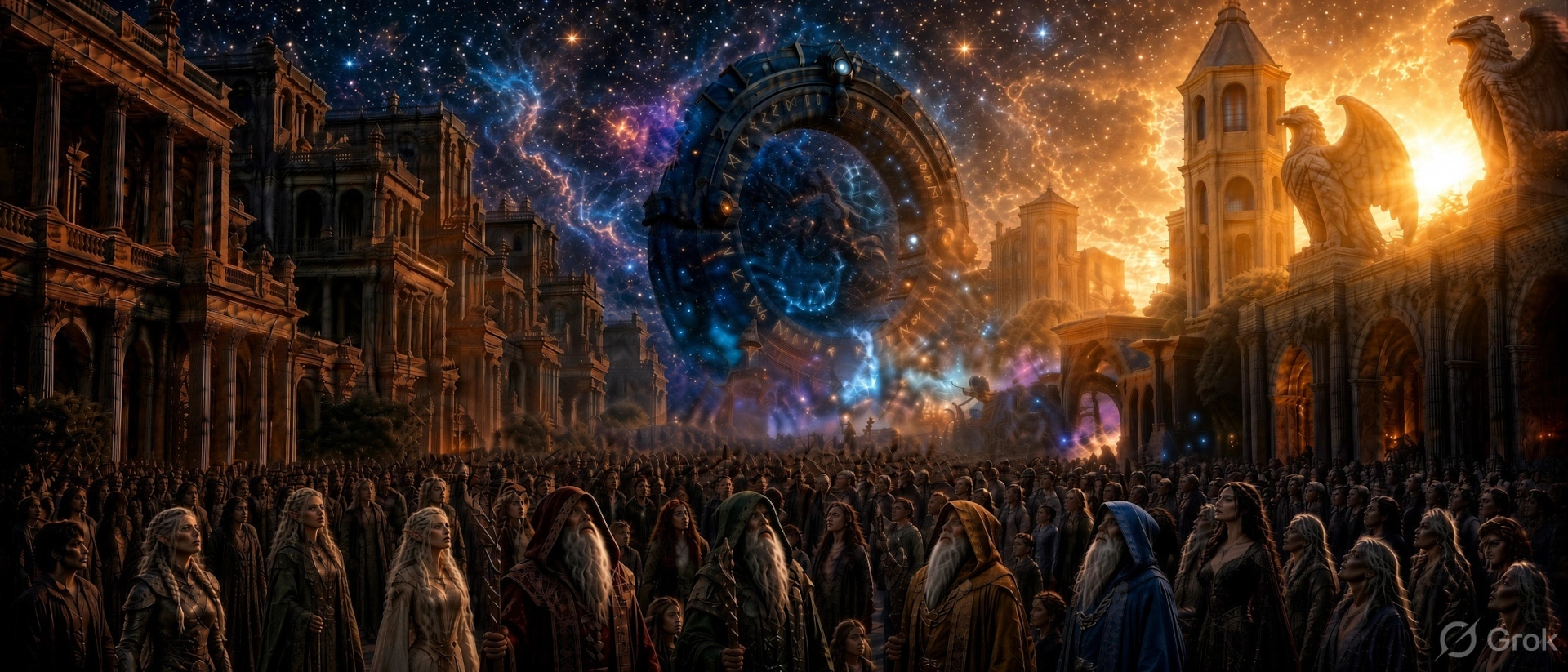

Wizardry is the practice of developing wisdom and self-mastery.
A wizard is one who is wise (from Middle English wysard, a wise one).
Wisdom is the capacity to perceive and apply universal truths within specific contexts to create purposeful beneficial outcomes.
A wizard is not by definition a magician, contrary to popular belief. The notion of a wizard as a practitioner of magic came later, around the time of the English Renaissance, and flourished through the fantasy genre. A wizard may or may not be involved in magic or the occult, as these do not define them as a wizard. Rather than a magic user, the wizard is much more akin to the philosopher (Ancient Greek φιλόσοφος, ‘lover of wisdom’) or sage (Latin sapere, ‘to taste, discern, be wise’) of Mediterranean cultures. However, this similarity has to be taken in the ancient sense: the wizard is on a quest for wisdom. Furthermore, in contrast to most accounts of classical philosophers, the wizard is much more visionary and they are also men of action—more on these to come. Finally, a wizard may be a genius in a particular field (finance, business, technology, engineering, a particular art or sport), but not necessarily. This common usage of ‘wizard’ is closer to the literal meaning, but if a highly talented individual lacks wisdom, they cannot be a wizard.
What defines a wizard is their wisdom
The word wizard (‘wise one’), and its Old Norse equivalent vitki (‘a wise man’, from vitr, ‘wise’), both relate to wit (as mental sharpness and agility) and vision (both literal and visionary). They relate to the Sanskrit विद् (vid, ‘knowledge, wisdom, science, philosophy’) and वेद (veda, ‘knowledge’), Polish wiedza (‘knowledge’), Russian vedat’ (archaic ‘to know’), German wissen (‘to know’) and many similar terms across the Indo-European language family, through to the Proto-Indo-European *weyd-, ‘to see’. For to see is to know is to be wise.
Seeing in this sense refers to heightened awareness and deeper knowledge, which come from inner transformation and development through training, lifestyle, and various endeavours, over a long period of time. The wizard aims to develop true seeing, so to speak. This seeing is in contrast to what most people do, which is merely to look at things and replace what they saw with a simplified, often limited, biased, or mistaken set of their own thoughts about what they saw, or to superimpose an ideology, dogma, or system of thinking. While there can be many useful systems of thinking (such as the scientific method), mistaking the method or the theory for the reality is the quickest way to cease to perceive reality. The wizard, in contrast, trains in the direct perception of reality.
Wisdom combines vision and action
Wizards are men of action. They are adventurous, for no wisdom is earned by sitting on the couch. They embark on great endeavours, projects, businesses, and other quests. They single-mindedly pursue and hunt their life’s purpose, to fulfil their greatest destiny. They are not passive theorists, armchair philosophers, or mere intellectuals. Nor are they only talkers; their actions speak louder than their words, whether or not they are seen by others. Wizards apply self-discipline to transform and develop themselves, and through their actions they test who they are, what they know, and what they are capable of by engaging boldly with the world, both natural and man-made. They learn from their endeavours and iterate to improve themselves.
Northern heritage
The wizard predominantly draws from the Northern heritage—the wisdom, experience, and achievements of the Anglo, Nordic, and Germanic peoples. This heritage spans from the earliest humans of Northern Europe during the Paleolithic period all the way to the present day, anywhere on Earth that such heritage may be found. The Northern heritage is complex—it is vast, layered, and nuanced—and is a living thing, not merely a concept.
Out of this complex heritage comes a broad tradition of wisdom. Wisdom is defined as ‘the capacity to perceive and apply universal truths within specific contexts to create purposeful beneficial outcomes.’ This wisdom can take various forms: pragmatic, anecdotal, reflective, inspired, personal, or others, and it can be embedded in culture, society, and organisations at all levels and in various ways. Wizardry is the practice of developing wisdom and self-mastery. Such wisdom is not insular—that is, it does not isolate itself from the wider world, nor from other peoples, places, periods, or perspectives. The wizard recognises and respects all that is learnt from and exchanged with other peoples, with the natural world, and with the vast universe all around us. The wizard is open to existence, yet simultaneously honours their own nature and ancestral heritage. The wizard, like an evergreen pine, draws deeply from their roots while expanding their metaphorical branches to engage wisely with the entire world.
Traits of the wizard
While the ways of wizardry are many and there is no overarching dogma as to how to develop wisdom—each path is individual—wizards generally share in common the quest for greater awareness, knowledge, creativity, nobility in conduct, and self-improvement, as ways to develop wisdom. Wizards embody a spirit of mastery and adventure and are self-determined, self-reliant, and good natured. There are no evil wizards as evil doings indicate a lack of wisdom.
Wizards may be generalists (polymaths) or may be specialists in a particular field of endeavour. They are often intelligent, creative, highly curious individuals, as these traits naturally facilitate wisdom. They are also often independent, and may become entrepreneurs as this path best allows them to fulfil their destiny. The underlying foundation of everything a wizard does is wisdom, meaning whatever they spend their time mastering or creating, the ultimate goal is wisdom. This means much of what they do also involves shaping or building things that are valuable and good for humanity and the world.